

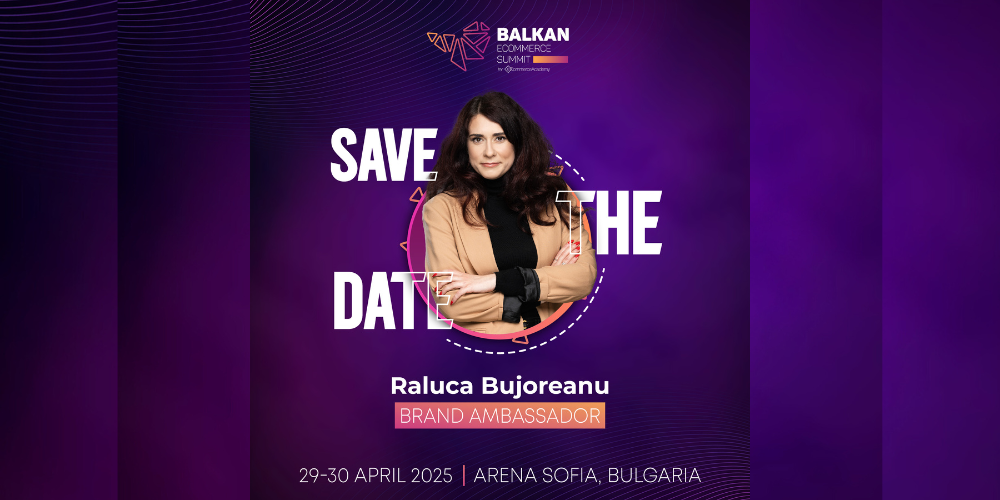
 Raluca Bujoreanu is a visionary leader in product strategy and digital innovation, with a strong track record in AI, AR, VR, and customer experience. As a former Product Leader at Zalando and co-founder at SHFTD, she has played a key role in shaping the future of eCommerce across Europe. With over 15 years of experience, Raluca has worked with major retailers, startups, and digital platforms to drive impactful product decisions and technological advancements.
As a brand ambassador for the Balkan eCommerce Summit 2025, Raluca is dedicated to bridging industry gaps, showcasing Eastern Europe’s rapid ecommerce growth, and driving digital transformation.
In this interview, she shares insights on the future of eCommerce, the impact of emerging technologies, and key strategies for business success in a competitive global market.
How do you see events like the Balkan eCommerce Summit 2025 shaping the future of eCommerce in the Balkans? What inspired you to take on the role of Brand Ambassador, and what impact do you aim to make in the industry through this position?
The Balkan eCommerce Summit brings together key players – marketplaces, retailers, and partners – at a time when businesses often need to expand beyond their home markets to continue growing and reaching their full revenue potential. Entering a new market requires more than just ambition; it demands deep insights into customer behavior, competitive dynamics, and leadership styles. This event helps businesses build the right connections and gain those insights that make expansion smoother and more successful.
Becoming an ambassador for this event is a personal decision, closely tied to my roots. I started my (eCommerce) career in Romania, before moving to Germany, where I’ve spent the past 12 years working with major retailers and brands. As I reconnected with leaders across Eastern Europe, I was struck by how fast the region has evolved – yet the broader industry hasn’t fully recognized this transformation. My goal is to bridge that gap, raise awareness of the opportunities in the region, and inspire retailers across Europe to take action.
You’ve worked with cutting-edge technologies like 3D and VFR at Zalando. How do you measure the success of these technologies in terms of customer satisfaction and business growth?
With new technologies, success isn’t just about immediate adoption – it’s about long-term impact. Innovation should solve a real problem, align with a clear opportunity, and be measured beyond short-term gains. With 3D and Virtual Fitting Rooms, the potential impact was clear – if we got it right, we could significantly evolve the online shopping experience, shaping it for the next five years in line with industry trends while also gaining a competitive edge.
For 3D, which I led from idea to implementation, the goal was to help customers interact with products in ways that reduce uncertainty – especially in luxury, where details matter. Customers want to see, feel, and experience products before committing, and 3D helped bridge that gap between offline and online shopping. Rather than focusing solely on conversion rates from day one, we looked for signals – customer engagement, brand adoption, and how well the technology scaled beyond luxury. This approach allowed us to continuously refine the experience and move faster toward our mid-term vision of the future shopping journey.
How do you prioritize features when working on a new product or platform, especially when balancing innovation with the user experience? What are the top 3 most important ones?
There are several ways to prioritize features, but what has worked best for me is using impact, confidence, and effort (ICE) – or RICE (adding Reach) if it’s a mature business with high traffic. These frameworks are useful, but if not applied correctly, they become just numbers on a page, leading to decisions based on intuition rather than data.
What I realized is that to make prioritization truly work, confidence needs to be precisely measured with a clear estimation based on factors like known trends, customer validation, and past business data. Without this, impact estimates can be misleading and driven by intuition rather than data. I also add strategic alignment as a separate dimension – a feature might seem valuable, but if it doesn’t contribute to key business priorities, it’s a distraction. Before prioritizing, teams need clear visibility on strategic goals so decisions drive the business forward, not just chase potential revenue.
How do you think startup businesses should adjust their strategies when expanding into new international markets?
Expanding internationally is not just about scaling – it’s about adapting. Startups must recognize three key differences in new markets:
- Decision-making behaviors – how customers evaluate and buy differs across cultures and industries.
- Competitive landscape & market maturity – positioning a brand in a saturated market requires a different approach than in an emerging one.
- Industry norms, business practices & cultural differences – regulations, sales strategies, and customer expectations often require a shift in approach.
These differences mean expansion isn’t just a rollout – it’s almost like launching from scratch. Through our work helping businesses expand across Europe – especially from Eastern Europe into Germany – we’ve seen that success comes from adjusting the marketing and messaging, pricing, sales strategy, and even the product itself to fit the market, rather than assuming what worked at home will work elsewhere.
As an expert in product strategy and digital experiences, what are the 3 most common mistakes eCommerce businesses make when designing their digital experiences?
- Not being clear on their core customer and their real problems. Without a deep understanding of customer needs, businesses end up with generic experiences that don’t truly solve pain points. Everything – UX, content, technology – should be built with the customer in mind.
- Copying competitors without questioning if it works. Just because a competitor launched a feature doesn’t mean it’s successful. Without knowing its impact or whether it fits their own audience, businesses waste effort chasing trends instead of differentiating.
- Focusing too much on small optimizations instead of rethinking the experience. Many companies spend time fine-tuning product pages instead of asking what the future of shopping will look like. Younger generations browse, shop, and engage differently. The businesses that will thrive aren’t just refining old rules – they’re anticipating what’s next based on how customers interact and shop in their industry.
If you had to bet on just one technology (AI, AR/VR, blockchain, conversational commerce, etc.) that will reshape eCommerce in the next decade, which would it be and why?
Virtual reality (VR).
AI is transforming efficiency and automation, but VR will redefine how people shop. It won’t just enhance eCommerce – it will change it entirely, merging offline and online experiences. From immersive virtual stores to interactive product exploration, VR will transform how customers browse, try, and buy, reshaping how brands sell in the digital world.
As Chief Future Architect, you help businesses prepare for the next wave of digital transformation. Looking ahead, how do you envision customer experience evolving in eCommerce over the next five years, and what should brands be doing today to stay ahead of consumer expectations?
Over the next five years, we’ll see a shift where the best parts of offline shopping – immersion, interaction, and personalization – are seamlessly integrated into digital commerce. Whether this happens in five or ten years depends on a major player taking the first step, but we’re already on that path. Younger generations are shaping new ways to shop through gaming and social media, and expectations are shifting fast.
To stay ahead, brands must start experimenting now. The excuse that “customers aren’t ready” is no longer valid – they are. The real question is: Are brands ready? Now is the time to create bold, forward-thinking experiences that bring real value to customers. Those who wait will fall behind, while those who embrace change will define the next era of commerce. Ane we’re committed to helping businesses lead this transformation.
Raluca Bujoreanu’s insights highlight the evolving landscape of digital commerce and the opportunities emerging in the Balkan region. With technology redefining the way businesses engage with consumers, staying ahead requires both vision and strategic execution. The path forward is one of transformation, and those who embrace change will define the next era of eCommerce.
📅 Don’t miss the chance to learn from industry pioneers like Raluca at the Balkan eCommerce Summit 2025. Secure your ticket today and stay ahead in the evolving world of eCommerce. Visit balkanecommerce.com for more details!