

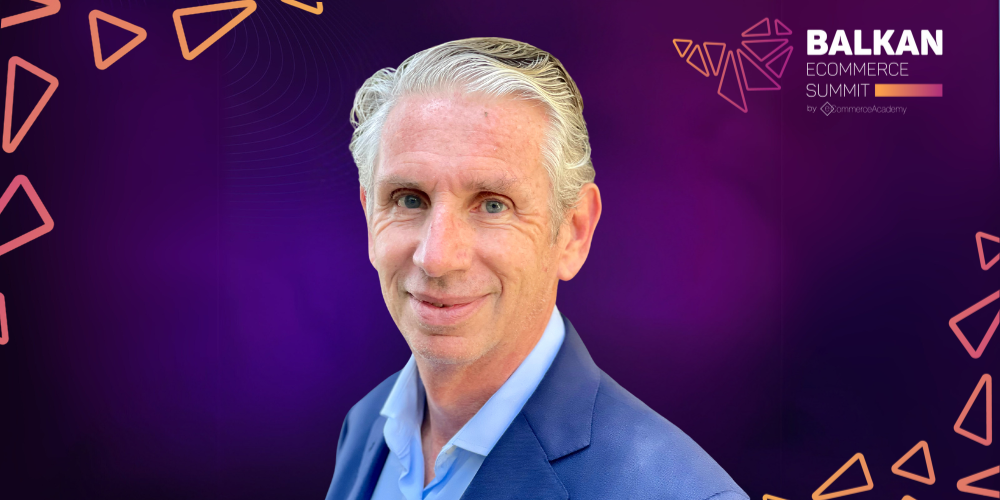
 Pascal Brochier, a global business visionary with over two decades of leadership expertise, will take the stage as a keynote speaker on Day 2 of the Balkan eCommerce Summit 2025. Known for transforming challenges into opportunities, Pascal has a track record of scaling businesses to extraordinary heights, driving digital innovation, and guiding teams with resilience and focus.
From leading powerhouse brands like Procter & Gamble to reshaping the future of start-ups, his journey offers a wealth of insights for entrepreneurs in emerging markets. Prepare to uncover game-changing strategies as Pascal shares his blueprint for sustainable growth and success in the ever-evolving world of eCommerce.
Drawing from your experience in rapidly scaling businesses, what critical factors contributed most to significant growth? How can online sellers in emerging markets replicate these strategies?
Drawing from over two decades of global experience in leadership roles, scaling businesses has hinged on a few core factors: (1) an unwavering focus on solving the customer needs that matter the most, (2) adaptability, and (3) building robust go-to-market strategies. For instance, during my time at Gillette, I expanded Braun’s power oral care division from $40 million to $400 million by understanding market needs and localizing strategies for each market.
For example, in some areas of the Balkan, as an eCommerce player, how critical is it to have a cash-on-delivery option or a localized customer support to build trust faster with your customers. Are there more important needs to address or are these 2 at the top of the list?
As a Partner at CEO Coaching International, you help leaders tackle complex challenges. What are the biggest hurdles in digital commerce, and how can they drive innovation while scaling?
In digital commerce, leaders often struggle with rapid technological changes, balancing innovation with operational efficiency, and scaling without losing sight of the core customer. To overcome these challenges, I encourage focusing on agility and data-driven decision-making.
Building a strong customer experience, for instance, by creating a streamlined mobile experience (given high mobile usage rates) and offering responsive customer service, can set companies apart. Addressing logistical challenges by communicating transparently about delivery times, as well as offering local pickup points, can make a huge difference in customer satisfaction. At CEO Coaching International, we focus on helping leaders understand these local preferences to drive more effective profitable growth strategies.
A clear, repeatable process for setting goals and tracking progress, such as the frameworks we use at CEO Coaching International, helps leaders align their teams and navigate fast-paced shifts in digital trends.
With the rapid rise of AI and its impact on eCommerce, how do you approach decision-making amidst technological uncertainty?
A great way to think about this is to work with your team on a framework that prioritizes initiatives based on the size of the impact and the ease of implementation for key technology solutions, including AI-driven initiatives. Start now with the low hanging fruits (immediate significant impact with easy implementation) and do not get distracted by “shiny objects” that may look cool but have low impact and are hard to implement.
For example, are there simple things you can do, using technology, to directly enhance user experience,
Your experience in launching new markets is invaluable. What advice would you offer to Balkan entrepreneurs looking to disrupt the eCommerce landscape?
As an entrepreneur in the Balkans, I would ask for example: do we have a prime opportunity to disrupt the market by focusing on hyper-localized customer experiences. For instance, developing logistics partnerships to ensure reliable and fast delivery to rural areas can address a common pain point. Adding transparency around order status – such as SMS updates on delivery – is also highly valued by customers.
Could you share a moment from your leadership journey where you overcame adversity, and what lessons did you learn?
In early 2016, I joined Giroptic, a start-up that had developed amazing technology in the virtual reality space. 18 months efore I got involved, they had launched one of the first 360 cameras with real-time stitching providing amazing immersive images in real time. They raised $1.4M on Kickstarter with 6,000 early adopters who were promised to receive their camera a few months later.
When I got involved, the company was 18 months late and the early backers were starting to lose patience and confidence in its ability to deliver on its promise. It was a really tough time. We had to do 2 things quickly: first deliver on our promise to our customers and do it fast to restore credibility and second kill that project which was not economically viable in the future and pivot to a simpler version that could leapfrog the competition. It was a tough time because we were running out of cash. The team was demoralized and we had to quickly find a path to success.
We did that in 3 months and refocused on simpler things we could control. It was a huge win as we earned Facebook’s (now Meta) support. In 2017, at Facebook’s F8 developer conference, every attendee got our camera as a gift paid for by Facebook. The team scored a huge win then.
Key learnings: Stay focused on what you can control, make fast decisions to kill projects with no future, and communicate clearly where you want to go. Inspire the team to work hard to come out the other side as a winner.
What misconceptions do businesses have about digital transformation, and how can they avoid common pitfalls?
Few companies are successfully focused on anticipating customer needs rather than solving yesterday’s needs. It is an easy path to focus on “shiny objects” features that could become irrelevant in 3 months’ time. The challenge is to successfully integrate new technologies that will be of great value to your customers at the time you release them.
Being passionate about the arts, how do you see creativity intersecting with business innovation?
Artists have the ability to successfully tap into people’s imagination and emotions. Great business innovations make our lives better. Both can stretch the boundaries of what we believe is possible.
One similarity is that most innovations come from a great vision, hard work and an iterative process to constantly improve. They rarely come randomly in one stroke.
The most successful entrepreneurs I have come across all have a great vision and great resilience. In my view, this is where great artistic creativity intersects with great business innovation.
Get Inspired by Pascal Brochier at the Balkan eCommerce Summit 2025
Pascal Brochier’s expertise offers a roadmap for innovation, resilience, and customer-focused strategies in eCommerce. Don’t miss his keynote at the Balkan eCommerce Summit 2025, where he’ll share actionable strategies tailored to emerging markets. 👉 Join the conversation and secure your spot at balkanecommerce.com